
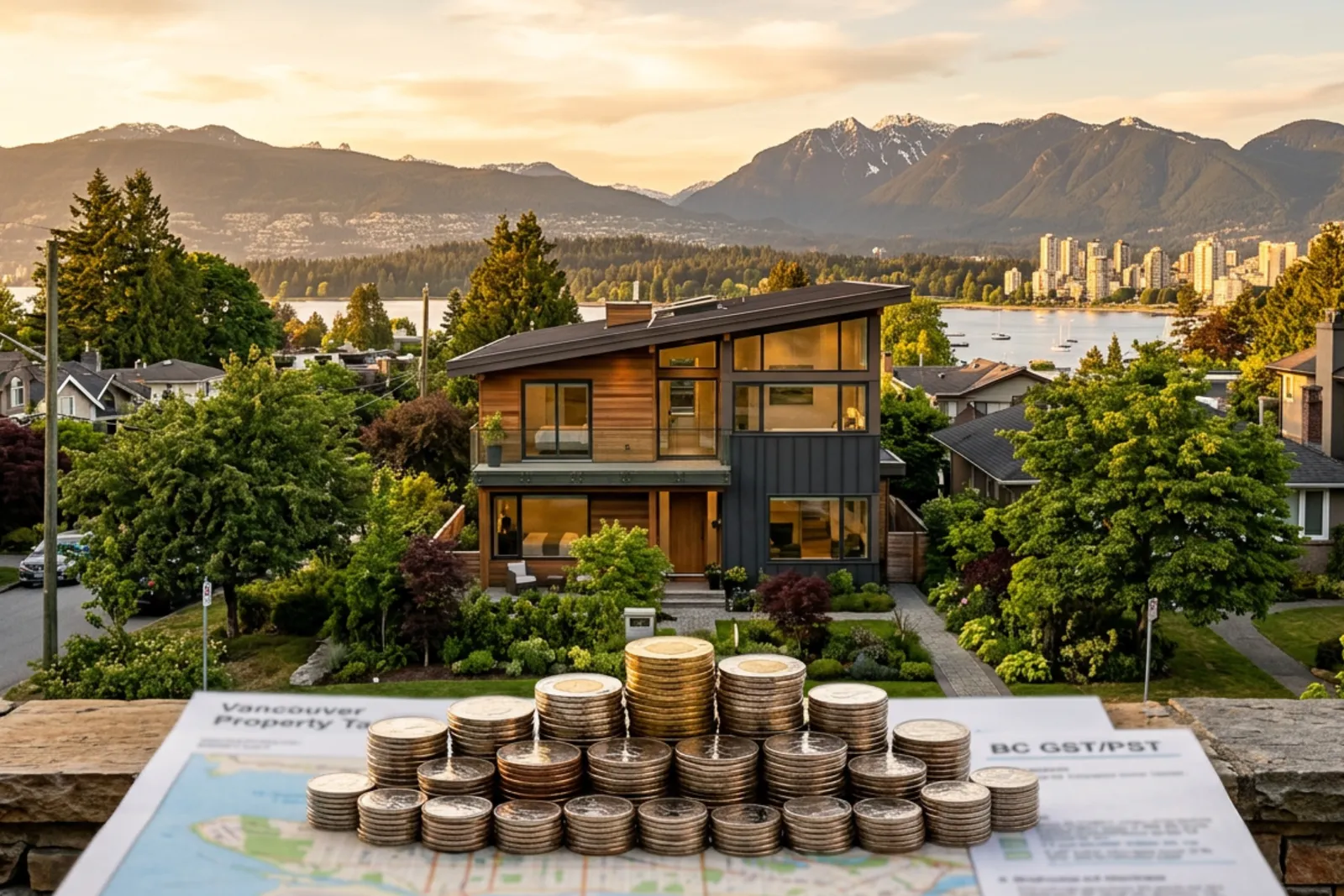
How British Columbia Property Transfer Tax Changes by Price Band
Learn how British Columbia Property Transfer Tax changes by price band and budget confidently for your home purchase. Read the guide today.
September 19, 2026
Buying a home in British Columbia comes with more closing costs than many people expect. Property Transfer Tax, usually called PTT, is one of the biggest. It is paid when a property transfer is registered with the Land Title Office, and it is separate from the annual property taxes owners pay to their municipality or rural tax office.
For buyers in North Vancouver real estate, Vancouver real estate, West Vancouver, Burnaby, Coquitlam, and elsewhere in the Lower Mainland, PTT can range from a few thousand dollars to well over $100,000. The reason is simple: British Columbia uses a tiered tax system. Each portion of a property’s value is taxed at a different rate, and higher-value residential properties may face an extra surtax.
The thresholds matter. A purchase price that rises by $25,000 will not always add the same amount of tax. Once a purchase crosses a threshold, the portion above that line is taxed differently.
Here is how the system works and what buyers should understand before budgeting for a purchase.
What Is Property Transfer Tax?
Property Transfer Tax applies when someone purchases or gains an interest in property registered through the B.C. Land Title Office, unless an exemption applies.
The tax may apply to more than a standard home purchase. Transactions that can trigger PTT include:
Agreement for sale transactions
Fee simple purchases
Foreclosures
Life estates
Lease modifications and prepaid leases
Court-ordered transfers
Quit claim transfers
Amalgamations
Forfeitures and escheats
Transactions that correct an earlier registration
The purchaser is generally responsible for filing the PTT return and paying the tax. In a typical home buying transaction, a lawyer or notary handles the filing and payment as part of the closing process. Still, it is the buyer’s responsibility to ensure enough funds are available.
PTT is usually due when the transfer is registered. It is not something a buyer can casually put off until next year’s tax bill arrives. That distinction catches people off guard.
Property Transfer Tax Is Based on Fair Market Value
PTT is calculated using the property’s fair market value, often shortened to FMV, on the date the transfer is registered.
Fair market value means the amount a willing buyer would pay a willing seller in an open market. In many ordinary resale transactions, the agreed purchase price is the best evidence of fair market value. If a home was openly listed, exposed to buyers, and registered within a reasonable period after the contract was signed, the purchase price will usually be accepted.
But purchase price and fair market value are not always identical.
A transfer may need more support when:
The property’s value changed significantly between the contract date and registration date.
The property condition changed before completion, perhaps after substantial renovation, damage, or new construction.
The parties did not negotiate in an open market.
The transfer occurs between family members, related corporations, business partners, or parties with another close connection.
The price is unusually low for reasons unrelated to the market.
In those cases, the province may require evidence of the property’s actual market value. An independent appraisal is often the strongest support. A BC Assessment value may sometimes help, but it has limits.
BC Assessment values are based on a valuation date of July 1 in the prior year and the property’s physical condition as of October 31 of that year. In a fast-moving market, that can feel old very quickly. It may be especially unsuitable if the land was rezoned, a home was substantially rebuilt, a new structure was added, market conditions changed materially, or the land is classified as farm land under Class 9.
For a standard arm’s-length purchase in the Lower Mainland, this distinction may feel academic. For a family transfer, private sale, redevelopment site, or complex estate matter, it can make a substantial difference.
The Three Parts of PTT You May Need to Consider
There are three possible tax components in a B.C. property transfer:
General Property Transfer Tax, which applies to taxable property transfers.
A further 2% tax on the residential portion of property value above $3 million.
Additional Property Transfer Tax for certain foreign nationals, foreign corporations, and taxable trustees purchasing residential property in specified areas.
Most buyers focus first on the general tax. Buyers purchasing high-value homes, mixed-use property, or property through certain entities need to look beyond that first calculation.
General Property Transfer Tax Rates
The general PTT rate is calculated in tiers. You do not apply one rate to the whole purchase price. Instead, each slice of the fair market value is taxed at the rate for that band.
Portion of Fair Market ValueGeneral PTT RateUp to and including $200,0001%Over $200,000 up to and including $2,000,0002%Over $2,000,0003%
This is similar to how graduated income tax systems work. Crossing into a higher band does not cause the entire purchase price to be taxed at the new rate.
That is good news for buyers. It also means the calculation needs to be done carefully.
Example: A $900,000 Home
Suppose you purchase a home for $900,000 and the purchase price is accepted as its fair market value.
The general PTT calculation is:
First $200,000 at 1% = $2,000
Remaining $700,000 at 2% = $14,000
Total general PTT: $16,000
The buyer does not pay 2% on the entire $900,000. Only the amount above $200,000 is taxed at 2%.
Example: A $2,000,000 Home
Now consider a $2 million purchase.
First $200,000 at 1% = $2,000
Next $1,800,000 at 2% = $36,000
Total general PTT: $38,000
This number is worth pausing on. A buyer who has saved for a large down payment may still need to produce $38,000 in PTT on top of legal fees, appraisal costs, inspection expenses, mortgage-related fees, moving costs, and adjustments. PTT is often one of the largest cash-to-close items because it cannot usually be rolled into the mortgage.
Example: A $2,500,000 Home
For a $2.5 million purchase:
First $200,000 at 1% = $2,000
Next $1,800,000 at 2% = $36,000
Remaining $500,000 at 3% = $15,000
Total general PTT: $53,000
The tax rises faster once the property value goes above $2 million because every additional dollar is subject to the 3% rate.
The $3 Million Threshold and the Further 2% Residential Tax
There is an additional 2% tax on the residential portion of a property’s fair market value above $3 million.
This applies on top of the general PTT. It is easy to miss because buyers sometimes hear that the top general PTT rate is 3% and assume that is the final rate. It is not necessarily the final rate for a high-value residential purchase.
For the residential portion above $3 million, the combined provincial tax rate becomes 5% before considering any foreign buyer tax.
Example: A $3,500,000 Residential Property
Assume the property is entirely residential and has a fair market value of $3.5 million.
First, calculate the general PTT:
First $200,000 at 1% = $2,000
Next $1,800,000 at 2% = $36,000
Remaining $1,500,000 at 3% = $45,000
General PTT: $83,000
Then calculate the further 2% tax:
Amount above $3,000,000: $500,000
$500,000 at 2% = $10,000
Further 2% residential tax: $10,000
Total PTT: $93,000
At $3.5 million, the buyer pays $93,000 in provincial transfer tax before exemptions or other applicable charges are considered.
Mixed-Use Properties Need a Different Calculation
The further 2% tax applies only to the residential portion of the property. This matters for mixed-use buildings, such as a storefront with residential units above it, or a property that combines commercial and residential uses.
The general PTT still applies to the taxable transaction based on the applicable fair market value. The extra 2% is limited to the residential value over $3 million.
Determining that split may require professional advice and supporting valuation evidence. It is not wise to make an informal guess, particularly where the residential component is significant.
There is also a narrow rule involving land classified as farm land solely because of an owner or farmer dwelling. Up to 0.5 hectares of that land may be treated as residential for the further 2% tax calculation.
Additional Property Transfer Tax for Foreign Buyers
Foreign nationals, foreign corporations, and taxable trustees may need to pay Additional Property Transfer Tax when they purchase residential property in specified areas of British Columbia.
This tax is separate from the general PTT and separate from the further 2% tax on residential value above $3 million. Its application depends on the buyer’s status, the structure used to acquire the property, the property type, and its location.
The specified areas include major population centers where many Lower Mainland purchases occur. A buyer considering property in North Vancouver, Vancouver, West Vancouver, Burnaby, Coquitlam, or nearby communities should confirm whether the property falls within an area where the additional tax applies.
The rules can also apply in situations that are not obvious at first glance. For example, ownership through a corporation or trust may still create additional tax obligations depending on who controls or benefits from the entity. The PTT return includes questions about foreign entity shareholders and may require supporting documentation.
This is a situation where getting clear legal advice before removing conditions is far better than discovering an unexpected tax bill just before completion.
Why Price Bands Matter When You Make an Offer
PTT is graduated, so there is no single cliff where the full property value suddenly gets taxed at a higher rate. Still, the thresholds matter because the marginal cost of each additional dollar changes.
Here is how the tax changes once a buyer enters each band:
Property Value BandGeneral Tax on the Next DollarFirst $200,0001%$200,000 to $2,000,0002%Above $2,000,0003%Residential value above $3,000,0005% total, before foreign buyer tax
For a home priced below $2 million, every additional $10,000 generally adds $200 in general PTT. Above $2 million, that same $10,000 adds $300 in general PTT. Above $3 million, where the further residential tax applies, every additional $10,000 of residential value adds $500 in provincial transfer tax.
That does not mean buyers should make decisions based on PTT alone. A suitable home is a long-term decision, and the purchase price itself is far more significant than the tax on a small price difference. But buyers should include PTT in their full budget when deciding how far to stretch.
A $2.05 million offer, for example, has a slightly higher tax cost than a $1.99 million offer, and it may also affect mortgage qualification, down payment requirements, and monthly carrying costs. The tax is one piece of the larger picture.
Transfers Involving Multiple Parcels
Some properties involve more than one legal parcel. A house may sit across separate lots, or a purchaser may acquire neighboring parcels that share an improvement such as a building, driveway, utility system, or other structure.
When parcels share an improvement and are transferred to the same person, related individuals, or associated corporations, they may be treated as a single parcel for fair market value and PTT purposes if certain conditions are met. Each parcel must be part of a taxable transaction, and the parcels must be transferred in one transaction or in multiple transactions within six months.
When the province treats the transfers as one taxable transaction, the registration date for all parcels is generally the date the first registration application is filed.
This rule can matter because the tax is tiered. Splitting related acquisitions into separate registrations does not necessarily mean each parcel will be assessed independently. Anyone buying adjacent lots, redevelopment land, or property through a corporate structure should ask their legal professional how the rules apply before closing.
Filing the Return and Preparing for Closing
The PTT return is filed electronically. The online return system has been updated with newer fields and documentation requirements, including requirements that may apply to certain exemptions and foreign entity shareholders.
For most resale home purchases, your lawyer or notary will complete the filing process. Buyers should still review the information they provide. A PTT return may ask about residency, citizenship, corporate ownership, trustee status, exemptions, property use, and transaction details. Incorrect information can create serious problems later.
A practical closing budget should include:
Property Transfer Tax
Legal or notary fees and disbursements
GST, if applicable to a new home or certain other transactions
Mortgage registration and lender fees
Home inspection and appraisal costs
Strata document review costs, where relevant
Property tax, utility, strata fee, or rent adjustments
Moving expenses and immediate repairs
The PTT amount should be calculated early, ideally before making an offer. B.C. provides an online Property Transfer Tax calculator for an estimate, along with calculation examples for more complex circumstances. An estimate is useful, but it does not replace legal advice where an exemption, non-market transfer, trust, corporation, foreign buyer rule, or mixed-use property is involved.
Final Takeaway for B.C. Buyers
Property Transfer Tax is straightforward in concept but can become complicated quickly. The general rates are 1% on the first $200,000, 2% on the next portion up to $2 million, and 3% above $2 million. Residential value over $3 million may also be subject to a further 2% tax. Foreign buyer rules can add another major layer in specified areas.
For many Lower Mainland buyers, the practical lesson is simple: calculate PTT before you finalize your budget, not after your offer is accepted.
A $1 million home produces a very different tax bill than a $2.5 million home, and a high-value residential purchase above $3 million requires even closer attention. If the transfer is not an ordinary open-market sale, fair market value and supporting documents become just as important as the purchase contract itself.
Thinking about your next move?
Let's talk it through, no pressure, no obligation.
Book a Consultation